Thursday, December 15, 2011

Rock Review: Pyrite


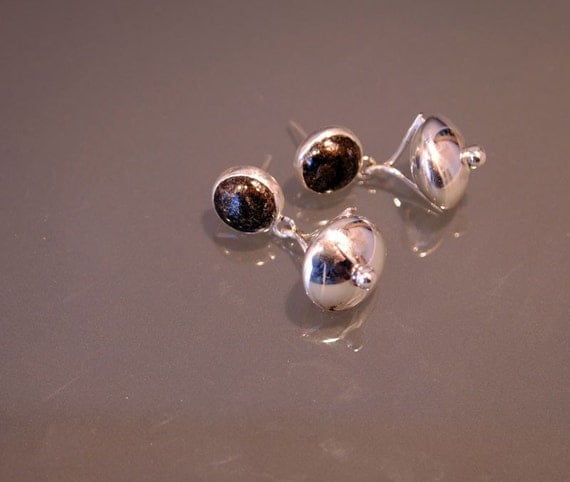
All that glitters is not gold, which is true in the case of today’s gem the gold doppelganger, Pyrite or Fool’s Gold.
Geology Buzz
Pyrite is actually a mineral compound of Iron and Sulfide. It can often be found in Quartz veins, coal beds and also as a replacement mineral in fossils. It is present in both sedimentary and metamorphic rocks. Although this mineral has been nicknamed Fool’s Gold, it sometimes can be found alongside real Gold or contain Gold traces within it’s crystalline structure when Arsenic is also present.
When Pyrite is exposed to water and oxygen together, it can oxidize and has the tendency to turn a rust color, thanks it’s Iron content. It is opaque with a gold to brass metal luster and registers a 6-6/5 on Moh’s scale of hardness. When your Pyrite jewelry needs a little TLC, it’s best to just stick to mild soap and water, being sure to dry thoroughly with a soft cloth. Also, it’s a good idea to store it in its own box or compartment so it doesn’t scratch your other jewelry, since it’s pointy planes are fairly hard.
Fun Facts
Pyrite comes from the Greek word “pyr” for fire. This is most likely because pyrite was used for quite some time as a counter part to produce a spark on steel, much like flint and steel. It was even used in early 16th and 17th century fire arms to create the spark that would ignite gun powder. It also was a component in early radio receivers that used crystal technology to conduct and receive radio signals. The Greeks and Romans also used Pyrite for jewelry because they believed the presence of the fire was contained inside the stone, making it a source of mysterious power.
Pyrite is a great jewelry choice for those who have a creative bent. It is believed to open both the right and left sides of the brain, releasing imagination and creative talents. It also is thought to promote a connection between the subconscious and conscious mind.

Thursday, December 8, 2011

Chrysocolla

Chrysocolla Formation


Today’s Rock Review features a “hometown” gem for those of us hailing from Pennsylvania, home state of Layne Designs Studio. It’s Chrysocolla!
Geology Buzz
Chysocolla ranges from blue to green in color, often appearing in lovely sea foam or teal tones. Because of its color, it’s sometimes confused for Turquoise, however it is a different gem altogether. It is a secondary ore of Copper. It forms in oxidation zones in veins of Copper ores over long periods of time as oxygen chemically changes the composition of the ores. In these veins it can form either as a crust or a rounded mass. Often, it forms along side or in conglomeration with other minerals such as Quartz, Limonite, Azurite, Malachite, Turquoise and Cuprite. That is why Chysocolla gemstone will often contain veins and traces of these gems as well.
It registers a 2.5-3.5 on Moh’s scale of hardness and therefore should be handled with care. Pure Chysocolla is too soft for the everyday wear and tear that occurs in jewelry, however when it forms in the presence of quartz, it becomes hard enough to fashion into a beautiful cabochon. It can also occur in druzy form, yielding am amazing natural Robin’s egg blue color.
Fun Facts
The name for Chrysocolla comes from the Greek words “Chysos”, meaning gold, and “Kolla” meaning glue. This is because they used the ore to solder gold. A metal smith named Theophrastus is the first person to be credited with using the material in 315 BC.
Not only does Chysocolla come from Pennsylvania, it also can be found in Israel, the republic of Congo, Chile, England, France, Arizona, Utah and New Mexico
As its color alludes, gemstone healers believe Chysocolla to have calming and cooling effects. It can be used to treat nervous disorders and bring a sense of peace. It also is applied in the treatment of fevers, infections, burns or cramps.

Thursday, December 1, 2011

Rock Review: Blue Topaz

December’s Birthstone is the icy Blue Topaz.
Geology Buzz
Topaz is a silicate mineral of aluminum and fluorine. It crystallizes in an orthorhombic crystal system, meaning it grows in rectangular prisms with rectangular bases. Pure Topaz is completely colorless. It gains it’s various colors from the presence of other elements that find their way into the mineral. Topaz is most commonly found in igneous rock deposits of Granite or Rhyolite.
Blue Topaz achieves its color when it is heated either by a natural source or by a man made source. Natural Blue Topaz can be quite rare. Three well known shades of Blue Topaz are Sky Blue, Swiss Blue and London Blue. London Blue closely resembles the color of Sapphire.
Fun Facts
Not only is Blue Topaz a December Birthstone, it’s also the state gemstone of Texas. Topaz is also one of the stones mentioned in the Bible in Exodus 28:17 as adorning the breast plate of the high priest of Israel.
Topaz gets its name from the Sanskrit work “tapas” meaning fire. Many ancient civilizations believed that Topaz had cooling properties, including the ability to cool a pot of boiling water. It’s also believed that this gemstone has a number of healing powers including the ability to cure insanity, poor vision, sleep disorders and asthma. Besides its use as a healing gem, today, giving a gift of Blue Topaz is symbolic of love and fidelity. What a perfect gift to give a loved one!

Blue Topaz Rocksy Necklace

Wednesday, November 23, 2011

Rock Review: Kunzite

With Thanksgiving just a day away, this week’s rock review will feature the stone of gratitude, Kunzite!


Geology Buzz
Kunzite is a version of the pyroxene mineral called Spodumene. It is made up of Lithium, Aluminum and Silicon compounds. It is usually pink or lavender in color due to the presence of Manganese. This is what makes it different from other types of Spodumene. The tone of Kunzite is often so light that it is frequently heat treated or irradiated to enhance its color.
Kunzite can also fade when exposed to sunlight, so it’s important to keep it stored safely when it’s not in use. It is a 6.5-7 on Moh’s scale of hardness, so it’s suitable for many types of jewelry, including rings and bracelets that may take on a bit more wear and tear during daily use.
A Kunzite stone that appears to be violet, pink or lavender from different angles can be attributed to a skilled gem cutter. When its planes are displayed well, it can take on almost an iridescent sort of look due to a trait called pleochroism.
Fun Facts
Kunzite was discovered in 1902 in San Diego county, California and named for George Kunz, who was the chief jeweler at Tiffany and Company at the time and a well known mineralogist. He was the first person to give a comprehensive description of the gem as its own variety.
Kunzite can be found in Brazil , the U.S.A, Mexico, Canada, Sweden Australia, Afghanistan and Pakistan. Today, other varieties of Spodumene are used as a source of lithium for batteries, ceramics, mobile phones and medicines just to name a few.
Kunzite is said to be the stone of gratitude and is thought to bring love, joy and peace to its wearers. It bestows upon it’s wearers a sense of calm and serenity. What a perfect choice for the holiday season as we count our blessings and draw our loved ones near.

Thursday, November 17, 2011

Rock Review: Morganite

Rainy November days can have you longing for a bit of cheer, which is why today’s rock review features the lovely Morganite.
Geology Buzz
Morganite comes from the Beryl family of gems. Beryls are beryllium aluminum silicate compounds. Pure Beryls are clear, however, the presence of other elements can change the color of the gemstone. When Manganese combines with Beryl, it produces a lovely subtle pink color that becomes more noticeable in larger gemstones. This makes size an important factor in selecting an Morganite gemstone. If the carat is small or the cut poor, the pink color is more difficult to see. Big and bright stones are the best choices to feature the gems unique traits. Occasionally orange and yellow tones can be found in this variety of Beryl also, often with color banding present.
Morganite registers a 7.5 to 8 on Moh’s scale of hardness. This makes it an ideal choice for any type of jewelry, including rings and bracelets.
Fun Facts
Until 1911 Morganite was simply known as Pink Beryl. It was named for business tycoon J.P. Morgan, who also happened to be a gem collector.
Gem healers use Morganite as a mood booster because it helps a wearer to concentrate on the brighter side of life, even in stressful times. It also radiates calming and relaxing vibes.
One of the largest Morganite stones ever found is called the Rose of Maine, and was found in 1989 at the Bennet Quarry in Buckfield Maine. It measured 9 inches long and 12 inches across, weighing in at just over 50 pounds. Now that’s a whopper!

Thursday, November 10, 2011

Rock Review: Tourmaline

This week’s rock review features Tourmaline!
Fun Facts
Tourmaline’s name comes from the word "Thuramali" or "Thoramalli" the word for gemstone in Sri Lanka. Many brightly colored Tourmalines were originally brought to Europe by the Dutch East India Company in the fifteenth century in order to interest Europeans in new and different types of gems, which were highly in demand at the time.
Today Tourmaline can be found in Brazil, Africa, Sri Lanka, Malawi, Afghanistan and a few locations in the U.S.A. Pink and green Tourmalines are currently mined in Maine and in California. Native American peoples in these locations had used Tourmaline for many years, giving green and pink varieties as commemorative gifts at funerals. That is no surprise to gem healers who use pink and green Tourmalines to enhance happiness and open the spirit to love from others.

Geology Buzz
Tourmaline is a  stone that comes is a wide variety of colors, but is seen in it's finest gem varieties usually in dark green and a variety of pink shades from light watermelon to fierce magenta. Tourmaline consists of aluminum, iron, magnesium, sodium, lithium and potassium. It is found in metamorphic rocks like granite, Marble and Schist.
Gems with a high iron content can be blue, black or brown. Gems containing large quantities of magnesium are brown and yellow. Gems with a high concentration of lithium can be almost any color. We get the very trendy Watermelon Tourmaline from the lithium based varieties. Some very special Tourmalines are dichroic, meaning they change color depending on the direction which they are viewed.
Tourmaline has a trigonal crystal structure and occurs in long thick and thin out cropping columns that take on a triangle shape. It is a 7-7/5 on Moh’s scale of hardness.


Natural Watermelon Tourmaline Slice

Friday, November 4, 2011

Rock Review: Citrine

Today’s Rock Review highlights Citrine! The birthstone of November.
Geology Buzz
Citrine is a member of the quartz family. Its name is derived from it’s lemon yellow color. However, the most valued citrines have an amber or reddish yellow tone to them. It is a very durable gem, scoring a 7 on Mohs scale of hardness. It also has relatively little cleavage, meaning it can take some impact with little likelihood of fracture.
In past decades, Citrine was marketed as “Golden Topaz”. That name has been hard to shake, since it often takes a skilled jeweler to identify the subtle differences between Citrine and Topaz. However, Topaz tends to be harder and heavier then Quartz, with a higher refractive index due to the presence of fluorine aluminum silicate. Topaz, however, has higher cleavage than Citrine and requires some care during the cutting process.
Fun Facts
Citrine historically has been found in Spain, France, Hungary and the Scottish Isle of Arran. More recently, Citrine has been discovered in Brazil, Bolivia, some African countries and parts of the Soviet Union.
The gem is thought to bring happiness, joy and optimism into its owner’s life. Gemstone healers often use the stone to increase self-esteem and open the mind to new thoughts. Tradition refers to Citrine as the “Merchant Stone”. Shop keepers often kept one in their cash boxes to maintain wealth and bring good fortune. Many shop owners still enjoy this practice today. Citrine was also worn to protect a wearer from snake venom.
Visit the Layne Designs Website to check out some of our work in Citrine!