Showing posts with label folk lore. Show all posts

Thursday, May 31, 2012

Rock Review: Flourite

Flourite is named for the Latin "fluo"-- to flow,  because it is used as an additive to aid in proper flow for iron smelting. Additionally, the phenomenon "flourescence" takes it's name from this stone where strong flourescence can commonly be observed under UV light.
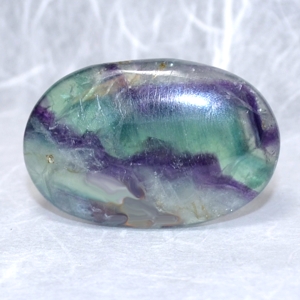
Excellent Specimens of flourite have beautiful, intense color banding in all shades of purple, mint green to teal, some pink and white. Strong color banding is a good way to identify flourite, but not all material is so fantastically banded. See below:
This is more common.

Flourite is found commonly cut into beads, and for other ornamental purposes. It can be found cut as a gemstone for setting in jewelry, but it is a relatively soft stone, making this practice uncommon.

This gem does have a common place in gemstone healing, however. It is thought to strengthen one's power of concentration. It is also used to cleanse the aura, and it is applied directly to an ailing part of the body to relieve pain.

Different colors of flourite are thought to have more specific benefits, more information on this here: http://www.charmsoflight.com/fluorite-healing-properties.html

Thursday, March 1, 2012

Rock Review: Diopside


As we enter March, we’ll review Diopside, the perfect companion for all the soon to emerge spring greens.
Geology Buzz
Diopside is a pyroxene mineral that is found in igneous and metamorphic rock deposits. It contains the elements Magnesium, Silicon, Oxygen and Calcium. It often is found in conjunction with Basalt, Olivine, Dolomite, Limestone, Marble and Andesite.
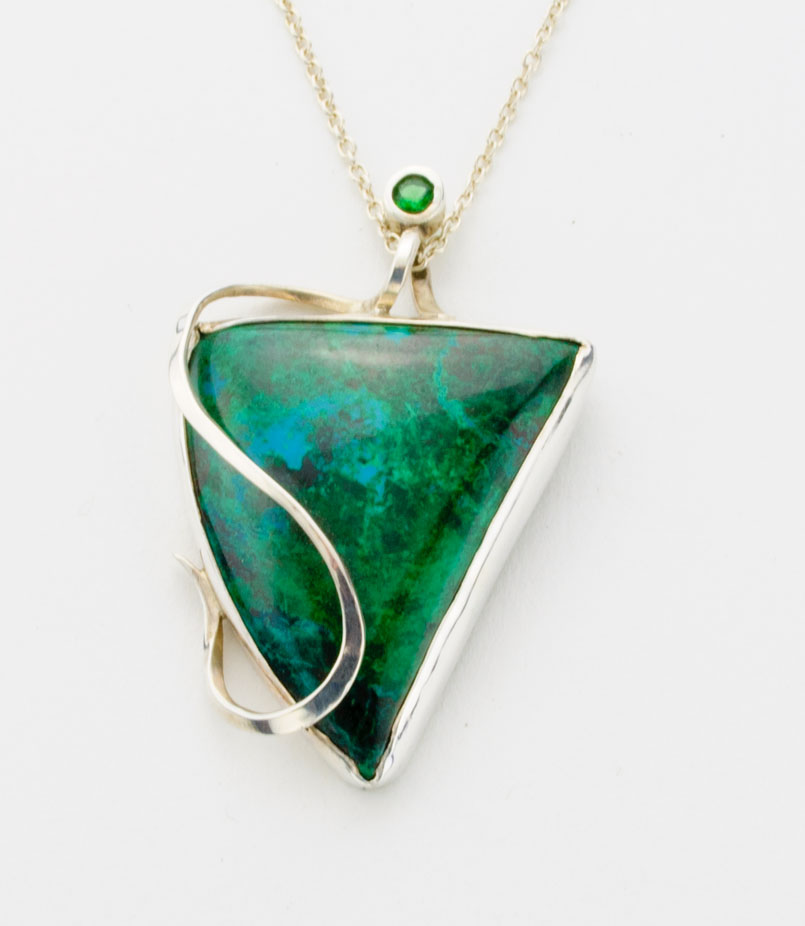
Gemstone quality versions of the mineral are usually called “Black Star Diopside or Chromium Diopside”. The presence of Chromium is responsible for the rich Kelly Green color (similar to an emerald) that is most often seen in jewelry. “Violane” is also a rare blue to violet color of Diopside that gets its tone from Manganese. White occurrences can fluoresce a bright powder blue color. Diopside registers between 5.6 and 6.5 on Moh’s scale of hardness.
Fun Facts
Discovered circa 1800, Diopside gets its name from the Greek language taking the words “dis” meaning two and “opse” meaning “face” to describe the two different ways it’s prisms can be oriented. Today, it is exported mainly from Russia, specifically from Siberia.
Diopside is a lesser known birthstone for the month of March and is also associated with the zodiac sign Pisces. It is believed to enhance creativity in problem solving, analytical abilities and achieving goals. It is also linked to love, commitment and the inner desires. It also is thought to be useful in healing the heart, lungs and circulatory system.
Diopside is fairly rare, however its price has still thankfully remained affordable. Chrome Diopside is usually available in smaller carat sizes since the gem usually appears darker as its size increases. Samples over 2 carats in size are much more rare and usually command a higher purchase price.

Thursday, February 2, 2012

Rock Review: Chalcedony

Today’s rock review features the very versatile Chalcedony.
Geology Buzz
Chalcedony is a Silica mineral composed of an interwoven combination of Quartz and Moganite crystal formations. Chalcedony is somewhat translucent and also has a waxy sheen that becomes vitreous when polished. It can occur in a wide array of colors, although it most often is found in brown gray or black tones. Many semiprecious gems are actually just different varieties of Chalcedony. Some examples are Agate, Aventurine, Carnelian, Chrysoprase, Helliotrope, Mtorolite, and Onyx.
Many of the brightly colored Chalcedony available for purchase in the gemstone market is dyed or treated to enhance color, giving us an even greater range of fabulous colors. In UV light, many varieties of Chalcedony appear fluorescent.
Fun Facts
Humans have been making good use of Chalcedony since the Bronze age. In the Mediterranean region many surviving examples of intricate seals depicting rulers and dignitaries are still in great condition. Hot wax does not stick to Chalcedony, which is why it is ideal as this type of tool. Other antique pieces of carved gemstone jewelry and beads are also readily found in the middle and near east from a variety of cultures.
In gem lore, Chalcedony is a believed to be a nurturing stone that promotes goodwill and positive relationships. It absorbs negative energy and brings the mind, body and spirit into harmony. Chalcedony also helps the body to better absorb and assimilate minerals into the veins. It also increases physical energy!
Check out these cool varieties of Chalcedony from Layne Designs.

Layne Designs Magenta Chalcedony Briolette Necklace (left)
Blue Chalcedony Nodule and Briolette Beads

Thursday, January 26, 2012

Rock Review: Kyanite


Have the winter blues? Instead of chasing them away, indulge in them a bit with a look at the lovely deep blue Kyanite.
Geology Buzz
Kyanite is a type of silicate mineral that is very rich in aluminum. It can be found in both sedimentary and metamorphic rocks. It’s lovely cobalt blue color is derived from the presence of aluminum. Occasionally, Kyanite can also be orange, if manganese is present during its development. Some Kyanite gems can have a cat’s eye effect that is beautiful to behold.
Kyanite has a special trait called anisotropism, meaning it’s hardness can vary based on the crystal structure present in each formation. It can be as low as a 4.5 on Moh’s scale of hardness and as high as a 7 depending on if it’s planes are parallel or perpendicular to the axis of the gem. A parallel plane is softer, where as a perpendicular plane is harder. This trait is also a key identifying feature of this particular gem. Kyanite also has perfect cleavage in one direction, making it well suited to certain gemstone cuts like baguette, octagon, oval and pear styles.
Fun Facts
Kyanite gets its name from the Greek word kyanos for blue. Although Kyanite was discovered in the 19th century, it has remained a lesser known gem to much of the gem world. Today, most Kyanite hails from India, although it can be found also stateside in North Carolina, Montana and Georgia.
Besides being used in jewelry, Kyanite is also used in many ceramics manufacturing processes. It also can be found in electronics or as an electric insulator.
Kyanite is a useful stone in balancing energy, making it a favorite for those who enjoy the metaphysical properties of gemstones and minerals. It instills a sense of tranquility in its wearers that makes it ideal for those practicing meditation. It’s also believed to assist with enhancing psychic abilities as well as lucid dreaming.

Thursday, January 19, 2012

Rock Review: Garnet


For those born in January, Garnet is your birth stone!
Geology Buzz
Garnets come in a wide array of varieties and colors based on their chemical compositions. You may have heard of Pyrope, Almandine, Spessartine, Grossular , Hessonite, Tsavorite, Uvarovite or Andradite. These are all species of Garnets! Garnets occur in a rainbow of colors including pink, brown, black, green, blue, purple, orange, red, yellow and even colorless. The most well known color of garnet is the transparent blood red or deep crimson tone that many people are attracted to found most commonly in Almandine Garnet. The rarest color of Garnet is the Blue Garnet which also has the ability to change its color under incandescent light.
Because the chemical makeup of Garnet can vary greatly depending on the variety, it also can score differently on Moh’s scale of hardness. Generally speaking, Garnets register a 6.5-7.5 on the scale.
Fun Facts
Garnets have been well loved and used in jewelry and art since the Romans ruled the world. In fact, the name for garnet is derived from the Latin word for pomegranate, due to the deep red color of many of the gems. The Romans and subsequent Barbarian cultures that occupied former Roman lands used the gem in a cloisonné technique inlaid in gold to depict artistic scenes and designs. Today, we use them mostly in either cut gem or druzy style jewelry. It is the state gem of both New York and Connecticut. Some unexpected industrial uses of garnet are as an abrasive for sandpaper and sand blasting, as well as an element in certain types of filtration systems.
Garnets are thought to be a protective gem for those on journeys. Giving Garnet as a gift can be interpreted as a symbol of love and wishes for safe travel and a speedy return home. Do you know any globe trotters who might benefit from some Garnet? Check out these finds in Garnet from Layne Designs.