Showing posts with label precious. Show all posts

Thursday, May 31, 2012

Rock Review: Flourite

Flourite is named for the Latin "fluo"-- to flow,  because it is used as an additive to aid in proper flow for iron smelting. Additionally, the phenomenon "flourescence" takes it's name from this stone where strong flourescence can commonly be observed under UV light.
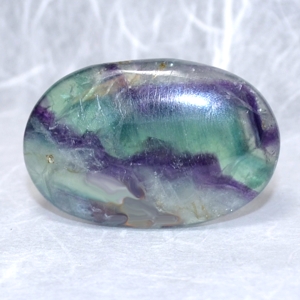
Excellent Specimens of flourite have beautiful, intense color banding in all shades of purple, mint green to teal, some pink and white. Strong color banding is a good way to identify flourite, but not all material is so fantastically banded. See below:
This is more common.

Flourite is found commonly cut into beads, and for other ornamental purposes. It can be found cut as a gemstone for setting in jewelry, but it is a relatively soft stone, making this practice uncommon.

This gem does have a common place in gemstone healing, however. It is thought to strengthen one's power of concentration. It is also used to cleanse the aura, and it is applied directly to an ailing part of the body to relieve pain.

Different colors of flourite are thought to have more specific benefits, more information on this here: http://www.charmsoflight.com/fluorite-healing-properties.html

Thursday, March 1, 2012

Rock Review: Diopside


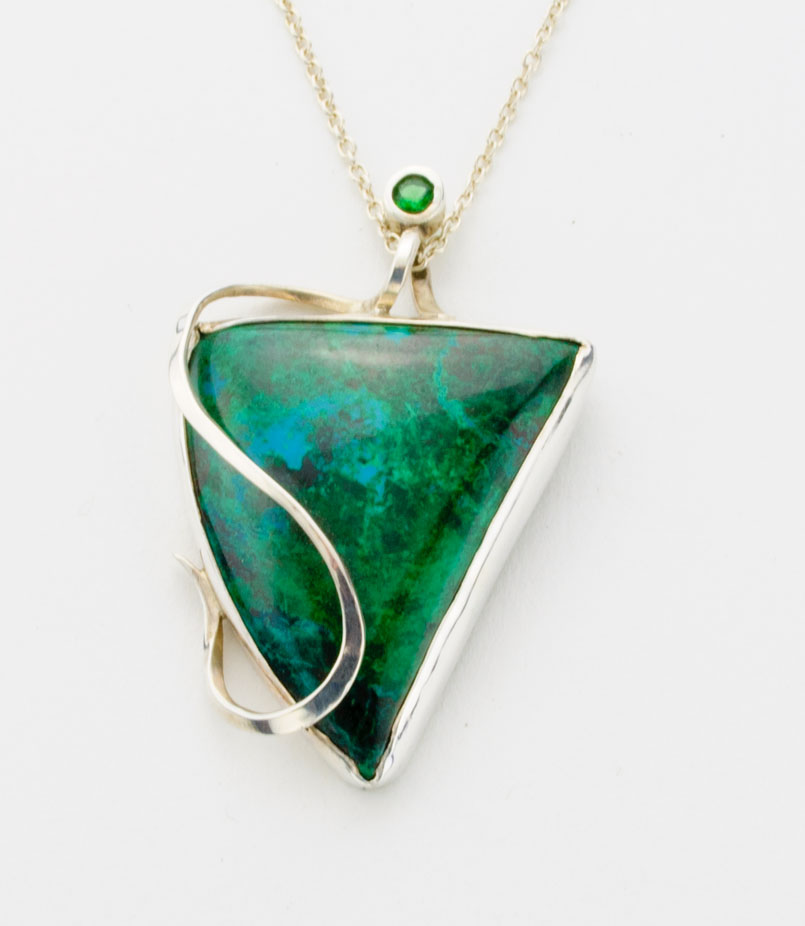
As we enter March, we’ll review Diopside, the perfect companion for all the soon to emerge spring greens.
Geology Buzz
Diopside is a pyroxene mineral that is found in igneous and metamorphic rock deposits. It contains the elements Magnesium, Silicon, Oxygen and Calcium. It often is found in conjunction with Basalt, Olivine, Dolomite, Limestone, Marble and Andesite.
Gemstone quality versions of the mineral are usually called “Black Star Diopside or Chromium Diopside”. The presence of Chromium is responsible for the rich Kelly Green color (similar to an emerald) that is most often seen in jewelry. “Violane” is also a rare blue to violet color of Diopside that gets its tone from Manganese. White occurrences can fluoresce a bright powder blue color. Diopside registers between 5.6 and 6.5 on Moh’s scale of hardness.
Fun Facts
Discovered circa 1800, Diopside gets its name from the Greek language taking the words “dis” meaning two and “opse” meaning “face” to describe the two different ways it’s prisms can be oriented. Today, it is exported mainly from Russia, specifically from Siberia.
Diopside is a lesser known birthstone for the month of March and is also associated with the zodiac sign Pisces. It is believed to enhance creativity in problem solving, analytical abilities and achieving goals. It is also linked to love, commitment and the inner desires. It also is thought to be useful in healing the heart, lungs and circulatory system.
Diopside is fairly rare, however its price has still thankfully remained affordable. Chrome Diopside is usually available in smaller carat sizes since the gem usually appears darker as its size increases. Samples over 2 carats in size are much more rare and usually command a higher purchase price.

Thursday, July 7, 2011

Rock Review: Ruby


July’s birthstone is Ruby, making it a perfect time to review this beloved gem! It’s name comes from the Latin word, ruber, meaning red. Rubies, also like Sapphires, come from the mineral Corundum (aluminum oxide), making these two stones “sister” gems. Rubies are often valued according to color, the most sought-after shade being a deep red “pigeon’s blood” color. Minimal inclusions and a glassy luster are also desirable qualities in a high end, natural Ruby.
There are many myths and legends surrounding the Ruby, which greatly accounts for the long term popularity of this lovely gem. For many cultures, it’s stunning red color naturally associates it with love, romance and passion. Hindus believed that the colors of Rubies were due to an inextinguishable fire that burned inside the gem. This fire was thought to grant it’s wearers long life. Native Americans used Rubies for ceremony offerings in hopes to be reborn as a chief. Burmese warriors believed that Rubies would protect from injury and make a soldier unconquerable in battle.
In final tribute to the gem of July, please enjoy the words of Ralph Waldo Emerson in praise of the Ruby! “They brought me Rubies from the mine, and held them to the sun; I said, “They are drops of frozen wine from Eden’s vats that run.” I look’d again – I thought them hearts of friends, to friends unknown; Tides that should warm each neighboring life are lock’d in sparkling stone. But fire to thaw that ruddy snow, to break enchanted ice, and give love’s scarlet tides to flow, when shall that sun arise?”

Thursday, June 30, 2011

Rock Review: Lapis Lazuli

Today’s rock review highlights the brilliantly blue Lapis Lazuli. Sometimes abbreviated to just Lapis (the word for stone in Latin), this semiprecious gem is known for its vibrant cobalt color that can contain marbling of yellow and cream tones as well as tiny flecks of gold. This rich spectrum comes from a combination of sodalite (blue), calcite (white) and pyrite (gold). It has a chalky luster, but still is able to take a high polish that enhances it’s lovely composition and makes it a prime choice for jewelry featuring a cabochon.
Lapis Lazuli was a very popular gem amongst ancient civilizations like the Egyptians, Mesopotamians, Greeks and Romans. The gem can be found in jewelry, large scale tile mosaics and in church art. One of the most famous examples of Lapis Lazuli used in church art is the at the tabernacle designed by Gian Lorenzo Bernini for the famous St. Peter’s Basilica in Rome. The edifice of the gilded bronze structure is encrusted with Lapis, the perfect contrast for the gold surface of the architecture. Cleopatra was even reported to use the powdered form of the stone for eyeshadow. While we don’t use Lapis as a cosmetic these days, it still is sometimes used in its ground form to give pigmentation to tempera and oil paints.
Most modern people prefer to enjoy their Lapis Lazuli in the form of jewelry. It is thought to grant its wearers insight, wisdom and enhanced intellect. The gem is very easily maintained at home and can be cleaned with a warm water and soap solution and a soft toothbrush when necessary. Below is a great example of Lapis Lazuli by Layne Designs. Contact Layne for information regarding availability.


Friday, June 24, 2011

Rock Review: Dendritic Opal

In today’s rock review will take a look at an “international gem of mystery”, the Dendritic Opal. It is found across the globe, and colors range in many neutral tones, from tans to grays often mottled with white. Part of what makes Dendritic Opal so beautiful is its dark branching formations called dendrites. They appear to be similar to moss or roots giving it a unique look that many people think is reminiscent of a fossil! However, the dendrite branches actually come from the mineral Manganese rather than fossilized plant life.
Luckily for Opal lovers, it is easy to maintain the gem at home since it can be cleaned with a simple dish soap and warm water solution then thoroughly dried with a soft cloth. Many people have long enjoyed Dendritic Opal for its metaphysical properties of promoting spiritual growth. It also is a popular gem with healers, aiding in treatment of blood, breathing and skin disorders. The famous Carl Faberge (think Feberge Egg) was a fan of Dendritic Opal and used it in a number of his pieces, some of which were supplied to the Russian imperial court. Many gem lovers in the 21st century are still enjoying Dendritic Opal for its unique marriage of rocky and organic looks.
Some confusion surrounds the stone’s identity and make up due to some aliases sometimes given to doppelgangers of this gem. For instance Dendritic Opal is often referred to as Merlinite which is actually a Chalcedony. Merlinite was dubbed an “Opal” because of its opalescence, but is not in fact an Opal. Agates with dendritic features are also sometimes labeled Dendritic Opal, but also are not authentic Opals. A true Dendritic Opal IS a common Opal, meaning it has no play of color, that also has the presence of dendrite formations.
Check out this lovely piece from Layne Designs in Dendritic Opal!


Dendritic Opal Ring from Layne Designs


Thursday, June 16, 2011

Rock Review: Smokey Quartz

Today’s gem, Smokey Quartz, gained a some popularity over the past year as it has been used to compliment the many grays and neutral tones we are finding in our closets these days. Smokey Quartz, as all Quartz, is a silicon dioxide crystal that forms over time as oxygen and silica based solutions that are present in the earth combine together. The dark gray/brown tones in Smokey Quartz are a result of “free silicon” by product of the chemical reaction that then colors the stone through irradiation.
Quartz is the second most prevalent mineral (Feldspar is first) in the world and is found in many sedimentary, igneous and metamorphic rocks. It can be found in widely known stones such as Granite, Rhyolite, Obsidian, and Sandstone. Some special varieties of Smokey Quartz are Morion and Cairngorm. Morion is the name for a color of Smokey Quartz that has a rich, even, glassy black appearance. Cairngorm is found in the Cairngorm mountains of Scotland and has a smokey yellow/brown or gray/brown color and is a popular trademark of traditional Scottish jewelry.
Many people prize quartz as mystical stone that possesses healing powers. Smokey Quartz in particular is believed to be useful in healing ailments of the abdomen, kidneys, pancreas, hips and legs. It also is useful for pain relief, particularly for headaches, muscle aches and nerve pain. Many varieties of quartz are also used to bring clarity to dreams, secure a peaceful sleep and instill a sense of well being.
Check out a recently made Cocktail ring from Layne Designs in Smokey Quartz. Contact Layne for more details on this beauty or a few of it's "friends" in other quartz varieties!

Thursday, June 9, 2011

Rock Review: Red Coral


The lovely warm weather has everyone thinking about the beach. So it’s the perfect time to review Red Coral which is one of the loveliest and most treasured gems from our oceans. Coral is a biogenic gem, meaning it’s developed through a biological process. Some other familiar biogenic gemstones are Pearls, Amber and Ivory. Red Coral is a unique living creature, part polyp and part skeleton, that grows slowly over many years as a result of calcium carbonate deposited by marine invertebrates after they die. Carotenoid pigments account for its beautiful red to pink color.
Coral has been used as jewelry and decoration for many centuries not only for its vibrant color but also because of cultural beliefs in its magical and medicinal qualities. Greek, Roman, Native American and even a few ancient barbarian tribes, such as the Gauls used the gem for protection, healing and ceremonial rituals. The Romans used it on pendants worn by children as talisman to ward off sickness and other dangers. Coral can often still be seen in Native American and southwest jewelry design, often paired with Turquoise, ever since the Spanish introduced the material to native peoples in the eighteenth century through trade.
The ethical use of Coral has been a hot topic in recent years. Because of its “slow grow” process, harvesting Coral from the oceans in unregulated quantities has become unsustainable because the Coral cannot grow quickly enough to meet human demand for it. This leaves jewelers and jewelry lovers with a dilemma. Is it ok to use and wear Coral? How can this be done in an ethical way? Layne Designs believes that it is important to be good stewards of our natural resources and only uses ethically traded materials in all of our work. In the case of coral, this means that we use vintage coral harvested prior to 1970 in our jewelry. Reusing existing resources through repurposing is a clever and creative way to enjoy the beauty of Coral without endangering its future. Check out one of Layne’s showpiece necklaces in Red Coral below.

Fabulous Red Coral Necklace by Layne Designs! Price Upon Request

Thursday, May 26, 2011

Rock Review: Turquoise

Sleeping Beauty Turquoise with Coral earrings on Etsy
Today’s featured gem, Turquoise, is one of the historically oldest mined gems in the world. It has been worn by many cultures over thousands of years in places like Turkey, Persia, Egypt and Mexico. It owes is name to the French who called it Turquoise since it was first brought to France from Turkey. A few other historical names for the stone can be found including Chalchihuitl in Aztec and Callais in Greek.
Turquoise is a hydrous phosphate of copper and aluminum that occurs over time when weathering, oxidation and percolating acidic solutions cause these minerals to chemically combine. The blue tones in Turquoise are a result of the presence of copper. Green and teal colors appear due either to dehydration or sometimes the presence of iron. One of the unique and beautiful properties of Turquoise is its trademark dark and somewhat shiny veins which are actually deposits of aluminum, pyrite and limonite. Turquoise is esteemed by many not only for it’s lovely robin’s egg blue color, but also for its waxy opaque luster which differs greatly from the abundance of glassy, faceted gems in today’s gem market and brings visual interest to a jewelry collection.
The American South West has long been known to be a major source of Turquoise in the world and the gem has become a staple of South West fashions. Other worldwide sources of the gem are found in the Middle East and in China. Many established Turquoise mines in the U.S. and abroad continue their operations today just as they have in decades past through seasonal, hand worked procedures that use little to no large scale machinery. Since the stone is so greatly loved across cultures and so carefully obtained, it’s likely that jewelry collectors will continue to hold Turquoise in high value for a few more millennia!

New Turquoise from Layne Designs:


Thursday, May 19, 2011

Rock Review: Cherry Creek Jasper

This week in the Rock Review, we’ll examine a stone that looks more like it could be a painting! Cherry Creek Jasper is known for its vibrant natural tones that form together creating a result that often looks like an abstract painting of a natural landscape. It has a wide range of color variation in the stone ranging from mustard to an apple red that even sometimes contains hints of an aqua tone or forest green. It’s trademark feature is lines of brown and dark gray that appear throughout this variegation of colors, taking on the appearance of trees or twigs.

Currently, this stone hails from China and is available in the U.S. in limited quantity. Cherry Creek Jasper is also known by a few other names such as Red Creek Stone and Red River Jasper. In realty, there is some debate regarding the stone’s qualification as a true Jasper because it differs on Moh’s scale of hardness from traditional Jasper. Cherry Creek Jasper scores a 6, while traditional Jaspers scores 7. It’s more likely that Cherry Creek Jasper is a type of silicified calcium-based stone such as dolomite. As Shakespeare commented “a rose by any other name would smell as sweet”, and this is exactly our opinion of Cherry Creek Jasper. It’s striking colors and unique patterns make it a delight for jewelers to work with and a joy for customers to own.
Check out some Cherry Creek Jasper currently available in our shop below!


Monday, May 9, 2011

Trend Watch: Druzy, Druzy Everywhere

By: Erica Delp

In today’s segment, we’ll examine Druzy! It seems like it’s been popping up everywhere lately. And why not? It’s a great way to add some shimmer to your summer outfits, whether you are stepping out in the day or night time. Since it often has an asymmetrical shape and of course a raw crystal surface it easily lends itself to bohemian and airy looks that define a summer wardrobe for most women. What a perfect way to bring some uniqueness and personality to your favorite outfits.

But what is a Druzy? Are all Druzy’s created equal? How can you make sure that you’re purchasing a quality piece of jewelry that will last? A deposit of Druzy crystals can occur on a great variety of already developed gemstones as geologic activity forces rocks to the earth’s surface where they can come into contact with other minerals and water. This mineral laden water flowing over the surface of the gemstones leaves beautiful unique deposits of crystals over time that can be extracted and fashioned into beautiful jewelry. Since Druzy is a crystal deposit that can occur on a wide variety of stones, it therefore can greatly differ in value depending on the worth of the base gemstone and the quality of the crystals. Druzy is commonly found in Quartz and Agate. It also can be found in Garnet, Hematite and Pyrite just to name a few others. Although Druzy crystals are hard, it is important to remember also that they are vulnerable to abrasion. Therefore, when selecting a piece of jewelry, a pendant or set of earrings will tend to have greater longevity than bracelets and rings. Unless of course, the later pieces have additional sheltering through their setting or will be worn delicately or infrequently.

Knowing these simple guidelines will help you to choose a piece of jewelry that will be so much more than a summer fling as you fall in love with it again and again each time you wear it! Check out some great Druzy creations for purchase from Layne Designs below.


Thursday, April 28, 2011

Rock Review: Uvarovite


In today’s rock review, we shine the spotlight on one of the rarer members of the Garnet family, the sparkling Uvarovite. Uvarovite has been known to the world since 1832 when it was discovered by Germain Henry Hess, a doctor and chemist who also pursued an interest in geology in his spare time. He chose to name it after Count Sergei Semenovitch Uvarov, a Russian statesman who also had a love for minerals and rocks.
The presence of Chromium accounts for it’s consistent Kelly green color which makes it very sought after by gem lovers who are looking for a true green with little variance. Occurring mainly in clusters of fine sized crystals, you’ll most often see this gem as druzy rather than a cut gemstone. It’s luster is Vitreous, meaning that the stone bears a clear and glassy appearance.
It is a 6.5-7 on Moh’s Scale of Hardness and therefore is durable; however, it is important to remember that as a druzy, special care is needed in its cleaning and maintenance so that the crystal deposits remain undamaged. Be sure to use only mild cleaners and avoid bringing chemicals in contact with the gems. You’ll get the most out wear out of Uvarovite, or any druzy for that matter, as a pendant, brooch, pair of earrings and other pieces that are less likely to incur abrasion.
This stone is mainly found in Spain, Russia and Canada, but also has made an appearance in a few other countries, such as Finland, Norway, South Africa and even in California. With luck, this stone will continue to be found in our jewelry boxes and on our persons as well for many more years to come!


Monday, March 7, 2011

Rock Review: Aquamarine

From the Latin, aqua (water) and mare (sea) This gem is named for it's water-like color. The gem appears in a range of colors, from just slightly blue to a brilliant sky blue. They are relatively tough gems, measuring an 8 out of 10 on the Moh's scale of hardness. This makes them especially suitable for jewelry. Wear your aquamarine with confidence, but be sure to clean it often, especially from behind the setting. These brilliant gems loose their sparkle quickly when smeared with dry skin, lotion and other particles.

Aquamarine comes from the same mineral family as emerald. Even thought they are so drastically different, they are both Beryl. Unlike emeralds, however, aqaumarine has a generally clear consistency with very few inclusions. This special trait made the aquamarine an excellent medium for Bernd Munsteiner, a stone cutting pioneer who invented the fantasy cut gemstone. Despite initial criticism in the 1960's, Munsteiner continued to sculpt gem into shapes that dramatically broke away from the standard formula of the past, like the one pictured above. The aquamarine was a favorite medium for him because of it's clarity. The fantasy cut lacks the light refraction of a standard cut gem, making any nasty inclusions easier to see.

Aquamarine has been worn for ages as jewelry. Among other things, it is thought to encourage long and happy marriages to women who wear it. Oh, and happy birthday to the March Babies out there. What a great birthstone!


Thursday, February 17, 2011

Rock Review: Pietersite


Pietersite was discovered by Sid Pieters in 1962 while he was prospecting farmland in Africa. After discovering this gemstone, he registered his find in the mineral records of Britain. There are only two known sources of Pietersite: Africa & China. The China form of pietersite came to market in 1997. This China pietersite exhibits slightly different color variations from Mr. Pieter's original mineral, but both are stunning and are now universally recognized as one-in-the-same.

Chinese pietersite has striking combinations of gold, red and blue color segments, which sometimes also includes a deep golden brown color. Blue is the rarest color, followed by red. The blues range from a baby blue to dark midnight hue. Golds can be light to very deep and rich, sometimes having a reddish hue. All fibrous color variations will have a superb and striking chatoyancy (NERD ALERT: chatoyancy means the bright and subtly changing shimmer of color that moves along the surface of a gemstone as it is viewed from varying angles.)

The fibrous structure in pietersite has been folded, stressed, even fractured and/or broken apart via the Earth's geologic processes. The fibrous materials have then been reformed and naturally recemented together by quartz. Stones and crystals that go through this process are referred to as brecciated, creating a finished product with multiple colors and hues.

Thursday, February 10, 2011

ROCK REVIEW: Amethyst


February already?!? Time for a new BIRTHSTONE Rock Review. This month’s birthstone is a beautiful stone ranging in hue from a nearly transparent lilac to deep purple – the lovely amethyst.

Amethyst is a type of rock belonging to the quartz family. Derived from the Greek word meaning "not drunken,” historians believe that the name came from the reddish purple shades of amethyst popular in the Greek states. Most of the amethyst used today comes from areas or regions of Mexico, Brazil, Africa and Uruguay.

According to legend, amethyst originated with Bacchus, the God of Wine. It was believed that drinking wine from a cup made of amethyst would prevent drunkenness and that wearing amethyst would prevent the wearer from becoming drunk being poisoned.

Amethyst is used as faceted stones or polished cabochons (a highly polished rounded unfaceted gem) and is carved in various shapes. Amethyst beads are used in necklaces, earrings and other jewelry in both rough unpolished forms, smooth glossy shapes, faceted beads and briolettes (a gem cut in the shape of a teardrop or oval.) One of the largest cut amethysts in the world is 343 carats and is housed at the National History Museum in London.

For another example of a gorgeous amethyst, please visit my Etsy shop:


Thursday, February 3, 2011

Rock Review: Rose Quartz

http://www.etsy.com/listing/60357008/rose-quartz-brandy-bracelet
I chose Rose Quartz today simply because it was pink and that seemed appropriate for Valentine's Day. Little did I know that Rose Quartz is actually known as the stone of love! It is believed that the stone can make the wearer feel a sense of self worth, and ignite passion in marriage. The stone is thought to heal and strengthen unconditional love rather than attract new love.
This stone is great for any kind of jewelry because it is very durable and resistant to scratches. It is also very comfortable to wear. At first it is cold to the touch but as it is worn, it becomes closer to your body temperature. Care for the stone is minimal, if you own a piece of rose quartz, it may be cleaned with soap and warm water and a toothbrush.
All stones in the quartz family have a very stable crystal structure and vibrational energy that is used to receive, send and hold energy. For this reason, quartz is used for practical purposes in watches and radios. This may be why healers and shamans from around the world have used the stone for centuries before this special property was proved by science. According to an article on fusionanomoly.net, the Amazonian shamans believe that spirits can become visible in quartz crystals.
While I may not be interested in seeing spirits in Quartz crystal, I am interested in the idea that this stone, worn close to my body is receiving and attuned to my body's vibrational frequency. I am interested that it is the stone of love and that perhaps it is able to use this balancing property to strengthen the bond between me and my love. How interesting indeed.


http://www.etsy.com/listing/39351790/rose-quartz-drop-pendant-with-pearls


Thursday, January 20, 2011

Rock Review: Dendritic Quartz

"cosmos ring" on etsy
While researching for this article, I learned something totally new! For the longest time, I was under the impression that my beautiful dendritic quartz stones were marked with impressions of fossilized plant material. That is what I had been told by the gem dealer who first sold me the stone. Even the word dendrite comes from the Greek “dendron” meaning “tree.” I continued buying the stone because it has such beautiful patterns, and it is a good, hearty stone. It is not easily scratched or broken.

I started looking things up about dendritic stones (they come in more than just
quartz) I found out that I was totally wrong about how those beautiful patterns got in the stone! My apologies for any previous mis-information on the subject. As it turns out, the patterns in dendritic quartz are part of a fascinating geological process. Where a deposit of quartz in the ground may have tiny fissures running through it, mineral solutions flow through the rock fissures. Hot mineral solutions including manganese and iron are percolating through the quartz base, and when cooled quickly, they are solidified and frozen in time!
I feel glad to have that cleared up. I learn something new every day. Do you have any favorite stones with fun patterns? Let me know, and I'll try to find out how the cool patterns got there!


Thursday, January 13, 2011

ROCK REVIEW: GARNET


Happy New Year! With a new year comes a new month, and this month’s beautiful birthstone is GARNET. Typically a red/brown color, garnet can be found in ANY color except for blue. Personally, one of my favorite garnet hues is a lovely magenta color known as Rhodolite garnet (see picture at the end of the blog post.) Found in abundance in Africa, garnet is also harvested in North and South America as well as in various European countries.

Derived from the Latin word for pomegranite, garnet has been used for centuries for its beauty but also for its supposed “lethal” nature. North American Indians used red garnets as arrowheads, believing that they would seek blood and inflict a deadlier wound, while as recently as 1892 the Hunzas of Kasmir used garnets as bullets to fight the British believing that garnets were deadlier than lead.

Also used frequently by early Christians to symbolize Christ’s sacrifice, and even earlier as a symbol by one of the 12 tribes of Israel, the garnet’s roots in history are as deep as any gemstone. A beautiful stone to highlight during these recently SNOWY, WHITE days of another northeastern US winter! Happy birthday to all garnet babies out there!!


Find this piece @

http://www.etsy.com/listing/64337710/sweet-sparkle-garnet-january-birthstone

Thursday, January 6, 2011

Rock Review: Labrodorite


As you may have guessed from my new series of blog posts "Rock Review" – I’m a bit of a nerd! I LOVE to know history and fun details about the materials I work with. It makes creating and designing with these incredible, naturally forming materials even more exciting! So, from time-to-time, I plan to enlighten myself (and hopefully my readers) with a bit of detailed research about ROCKS.
The next ROCK on my RADAR is the Labrodorite. Originally discovered on St. Paul Island in Labrador Canada in 1770, this rock ranges in color from a brilliant blue to grey and can sometimes include a rainbow of colors. It is one of the many stones classified in the feldspar family (nerd alert: feldspar family is defined as: a group of rock-forming minerals which make up as much as 60% of the Earth’s crust, per Wikipedia – and we know they don’t lie!)
Labrodorite is best known for its “shiller effect," or in layman’s terms its iridescent colors reflected at different angles. The scattering of light causes this effect from the thin layers in the stone, formed during the earth’s cooling process. This why the labordorite is so unique – depending on the angle from which it is viewed, a brilliant flash of different colors can be seen!
In addition to its country of origin, GEM QUAILITY labordorite can be found in Madagascar, Finland, Russia and most notably in India. Aside from its enchanting beauty, this stone also comes with an Eskimo legend! According to generations of Eskimo legend, labordorite holds the Northern Lights captive. A powerful Eskimo warrior found the Northern Lights captive in this rock and freed some of them with his spear. Not all of the lights escaped and that is why Labordorite displays an array beautiful colors today.
Another great example of beautiful labrodorite can be seen in these earrings at my ETSY shop:
A little fascinating fact and a little folklore legend makes for a great ROCK to REVIEW. Till next time!

Wednesday, December 29, 2010

Rock Review: Chinese Writing stone

http://www.etsy.com/listing/64925250/chinese-writing-stone-cocktail-ring

Chinese writing stone is a naturally occurring gem that is actually mined in the foothills of the Sierra Nevadas in California. Those who discovered the stone felt that the white crystal structure against the black stone looked like Chinese characters, hence the name Chinese writing stone. The majority of the stone is limestone, and the white flecks are andalusite crystals. Porphory is a second name for the stone exists which is rarely used in trade, though perhaps it is more PC. This gem is a recent discovery as rocks go. It was discovered during highway construction in the 1960's. It's beauty and durability make it a fantastic stone for jewelry making. It is a 5-6 on the Moh's scale of hardness, which makes it a reasonably tough stone. It is thought that Chinese writing stone is helpful in making a person dream. Pretty cool! Try sleeping with this ring on!