Showing posts with label cabochon. Show all posts

Thursday, May 31, 2012

Rock Review: Flourite

Flourite is named for the Latin "fluo"-- to flow,  because it is used as an additive to aid in proper flow for iron smelting. Additionally, the phenomenon "flourescence" takes it's name from this stone where strong flourescence can commonly be observed under UV light.
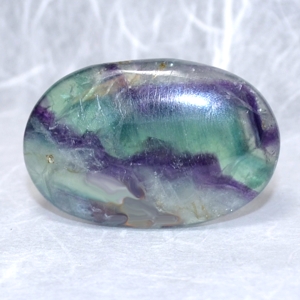
Excellent Specimens of flourite have beautiful, intense color banding in all shades of purple, mint green to teal, some pink and white. Strong color banding is a good way to identify flourite, but not all material is so fantastically banded. See below:
This is more common.

Flourite is found commonly cut into beads, and for other ornamental purposes. It can be found cut as a gemstone for setting in jewelry, but it is a relatively soft stone, making this practice uncommon.

This gem does have a common place in gemstone healing, however. It is thought to strengthen one's power of concentration. It is also used to cleanse the aura, and it is applied directly to an ailing part of the body to relieve pain.

Different colors of flourite are thought to have more specific benefits, more information on this here: http://www.charmsoflight.com/fluorite-healing-properties.html

Thursday, March 1, 2012

Rock Review: Diopside


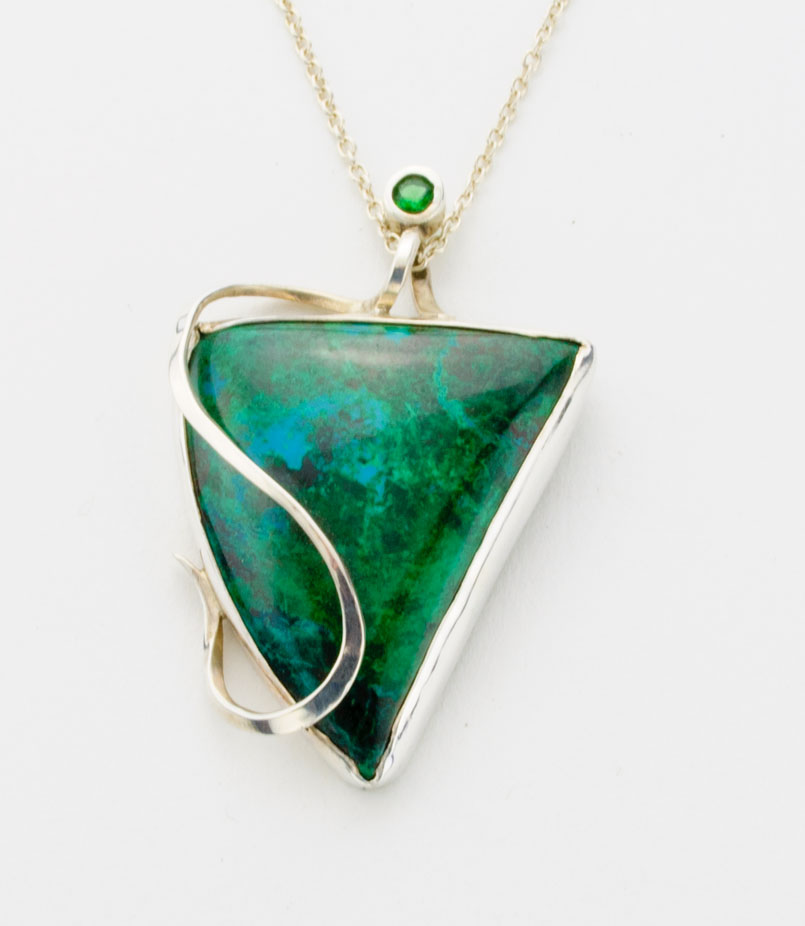
As we enter March, we’ll review Diopside, the perfect companion for all the soon to emerge spring greens.
Geology Buzz
Diopside is a pyroxene mineral that is found in igneous and metamorphic rock deposits. It contains the elements Magnesium, Silicon, Oxygen and Calcium. It often is found in conjunction with Basalt, Olivine, Dolomite, Limestone, Marble and Andesite.
Gemstone quality versions of the mineral are usually called “Black Star Diopside or Chromium Diopside”. The presence of Chromium is responsible for the rich Kelly Green color (similar to an emerald) that is most often seen in jewelry. “Violane” is also a rare blue to violet color of Diopside that gets its tone from Manganese. White occurrences can fluoresce a bright powder blue color. Diopside registers between 5.6 and 6.5 on Moh’s scale of hardness.
Fun Facts
Discovered circa 1800, Diopside gets its name from the Greek language taking the words “dis” meaning two and “opse” meaning “face” to describe the two different ways it’s prisms can be oriented. Today, it is exported mainly from Russia, specifically from Siberia.
Diopside is a lesser known birthstone for the month of March and is also associated with the zodiac sign Pisces. It is believed to enhance creativity in problem solving, analytical abilities and achieving goals. It is also linked to love, commitment and the inner desires. It also is thought to be useful in healing the heart, lungs and circulatory system.
Diopside is fairly rare, however its price has still thankfully remained affordable. Chrome Diopside is usually available in smaller carat sizes since the gem usually appears darker as its size increases. Samples over 2 carats in size are much more rare and usually command a higher purchase price.

Friday, February 24, 2012

Rock Review: Sodalite

Today’s rock review features Sodalite.

Geology Buzz

Sodalite is a mottled gemstone that most often has creamy yellow to white tones and royal blue colors mixed throughout the stone in interesting patterns. However, it can also occur in grey, yellow, pink and green if its chemical composition varies. It is named for the element Sodium than can be found in its makeup and belongs to the Feldspar family. It registers at 6 on Moh’s scale of hardness.


Sodalite is usually opaque, although translucent crystals can be found in larger deposits. It takes on a waxy luster when polished. Because of this, Sodalite is often found in beaded and cabochon form in jewelry. Sodalite can often be mistaken for Lapis Lazuli, however it almost never contains pyrite flecks present in Lapis. Also, it’s color is considered “Royal Blue” rather than “Ultramarine”. In streak tests, it will leave a white, rather than blue scrape.


Fun Facts


People began using Sodalite as ornamental decoration in the late 1800’s after a substantial quantity was found in Ontario, Canada in 1891. Bancroft, Ontario is known to produce Sodalite of with notably rich blue color. The mineral also can be found plentifully in Brazil and in China.

Sodalite is popular among individuals who enjoy the metaphysical properties of gems. It is thought to bring calmness and clarity to the mind, encouraging rational thinking, intuition and verbal expression. It also enhances confidence, self esteem and trust.


For care and maintenance, a soft polishing cloth will usually do the trick. A conservative dab of olive oil can also occasionally be used to enhance the luster and loosen dirt. This can be followed up with a quick rinse in warm water. Be sure to pat dry afterward. Because of its porous nature , Sodalite should not be soaked for long periods of time.

Friday, October 7, 2011

Rock Review: Sugilite

Today’s rock review features Sugilite.
Sugilite Cabachon

Geology Buzz
Sugilite is also known as Royal Luvulite and Royal Azel. It was first discovered in 1944 by a Japanese geologist named Ken-ichi Sugi on Iwagi Island and was named after him. Today, it can still be found in Japan as well as in Canada, India and South Africa.
It is an unusually deep natural pink to purple variety of Silicate mineral. It can be opaque or translucent with a waxy luster. Opaque dark purple is considered to be one of the most desirable and valuable forms of this gem. It is 6-7 on Moh’s scale of hardness. It’s complex chemical makeup, consisting of eight total elements, is a rare find and usually occurs in large masses, when it can be found. The gem contains Potassium, Sodium, Iron, Manganese, Aluminum, Lithium, Silicon and Oxygen that chemically combine to form prismatic crystals.
Fun Facts
Sugilite is sometimes nicknamed the purple turquoise. It is also thought to be one of the most powerful love stones, helping wearers to find beauty in difficult times, and forgiveness for those who have wronged them. It also is believed to balance the mind, body and spirit through granting peace of mind and a sense of general well being. Gem healers use Sugilite to aid in the treatment of dyslexia, pain, motor problems and lymph and blood purification.
Gem dealers predict that Sugilite will be growing in popularity in the next few years due to it’s great natural color, it’s durability and it potential to compliment other popular gems like Coral, Turquoise and Malachite. Be ahead of the trend and visit Layne Designs to add some Sugilite to your wardrobe.


Thursday, September 29, 2011

Rock Review: Mustard Jasper

This week’s rock review features Mustard Jasper! The name jasper is derived from old French word “jaspre” for spotted stone.
Geology Buzz
Mustard Jasper is somewhat uncommon as it is currently mined only in Indonesia from the top of an active volcano, making it a special find! It often is black or gray on the outer layers progressing to a rich mustard yellow on its inner layers. Jasper is formed from Silica and volcanic ash that are deposited and consolidated in the presence of heat and water over time. Patterns are created as sediments are layered and then compressed.
All Jaspers are a form of Chalcedony. Jasper is between a 6.5-7 on Moh’s scale of hardness. It is opaque and able to take a high polish making it a good choice for cabochon style jewelry.
Fun Facts
Jaspers are one of the birthstones listed for the sign star sign Virgo. It is also the Mystical birthstone for those born in the month of October.
Yellow Jaspers are thought to be associated with balancing and strengthening ones social standing. They also are used to give protection during travel and as a shield from negativity.Ancient European cultures used Jasper ceremonially to conjure rain. Legends say that Jasper drives away evil spirits and protects against snake and spider bites. Since Halloween is just around the corner, it might be just the right time to add jasper to your wardrobe!


Mustard Jasper Saturn Bracelet from Layne Designs, available for purchase!

Friday, September 23, 2011

Rock Review: Sapphire

All hail the Sapphire, gem of royalty and birthstone to all those born in September!
Geology Buzz
Sapphire is a part of the Corundum mineral family. When thinking of Sapphire, most people think of the lovely deep cobalt color that is the “classic” color for this gem. However, Sapphires actually occur in many colors including pink, yellow, purple, orange and green. When Corundum is crimson, we call that a Ruby. They are a hearty nine on Moh’s scale of hardness and have a vitreous, or glassy, luster. This makes this gem ideal as a faceted stone. Sapphires that fetch the highest price due to their desirability are deep blue in hue with up to 15% violet blue saturation.
Fun Facts
Many Sapphires have become famous throughout the years. One of these is the 423 carat Logan Sapphire, currently on display at the Museum of Natural History in Washington DC. It is a flawless specimen, hailing from Sri Lanka. Several notable specimens of Star Sapphire, Sapphire that naturally exhibits a reflective star shape known as asterism, are also on display at several museums. The Black Star of Queenland, discovered in Australia in the 1930s, is the largest sapphire known to exist. The Star of India, weighing in at 563 carats, is on display at the American Museum of National History in New York City. It was donated by famous robber baron J.P. Morgan in 1900 and has even survived a jewel theft! Thankfully it was recovered and returned to the museum for everyone to enjoy. The Star of Bombay, originally owned by silent film actress Mary Pickford, is also on display at the Smithsonian Museum of Natural History in Washington DC.
Long before William and Kate, Sapphires were used as the focal stone in engagement rings of royalty for hundreds of years. The tradition of Sapphires as engagement rings dates back to medieval times when they were worn as a physical symbol of faithfulness, honor and commitment of the betrothed during the engagement period. Considering popping the question? Think about a sapphire instead of a diamond to tell a bride to be that she’s your princess!


Logan Sapphire

Thursday, September 15, 2011

Rock Review: Obsidian

Today’s Rock Review features, the classic Obsidian!
Geology Buzz
Obsidian is a volcanic glass which occurs naturally, making it an igneous rock. Obsidian forms when lava containing the minerals Feldspar and Silica cools too quickly for large crystal formations to crop up. This process leaves Obsidian with its trademark smooth glassy surfaces.
It can be found in lava beds and usually ranges in color from smoky gray to deep jet black. The presence of other minerals, such as Iron or Magnesium can sometimes give the gem a reddish or green cast. A special kind of Obsidian called Snowflake Obsidian can occasionally be found when white crystals inclusions exist, creating a white fractal pattern. When bubbles are trapped in Obsidian, they can leave a golden or iridescent hue in the stone as well producing what gemologist call Rainbow Obsidian. A rare form of weathered Obsidian with a gray opaque band called Apache Tears can also be found on the San Carlos Indian reservation in Arizona. Who knew one gem could have some many different looks!
Fun Facts
People have been making good use of Obsidian since the caveman days, when early cultures used stone fragments for arrow and spear tips and other tools because of its naturally sharp angles when fractured. Greeks and Aztecs also used it as a primitive mirror. Today, we still use Obsidian as a cutting tool on surgical blades since it’s able to cut to a near molecular thinness and has a flat non jagged edge, even under an electron microscope.
Thankfully for those in jewelry business, people somewhere along the way found Obsidian to be ideal for adornment as well as utilitarian purposes. It makes a great beads as well as lovely cabochons. Many wearers enjoy the benefits of its metaphysical properties which include guarding against depression and sharpening insight.
Jewelry lovers who own Obsidian pieces should keep in mind that although the gem is sturdy, it is essentially glass, and therefore needs should be protected from blows that could lead to cracks and scratches and chips. Never clean this gem in an ultrasonic, steam cleaner or chemically based jewelry cleaning solutions. For care and maintenance, a rinse in warm water and polish with a soft cloth will do the trick.


Monday, September 5, 2011

Rock Review: Carnelian


Carnelian and Jasper Pendant by Layne Designs

In today’s rock review, we discover Carnelian. It’s perfect gem to usher in fall in hues, or orange red and brown.

Geology Buzz

Carnelian is a rust colored mineral that is often used as a semi-precious gemstone in jewelry and decorative art. It is a type Chalcedony that derives its color from the presence of iron and can range from pale orange to nearly black. It is between a 6-7 on Moh’s scale of hardness, has a vitreous luster and is translucent. Sard is the name of a slightly harder and darker version of Carnelian, however, the names are used interchangeably at times since there is such little variance between the two gems.

Fun Facts

Carnelian can be found often in ancient cultures like the Phoenicians, Romans, Greeks, Syrians, Hebrews and Egyptians. It was a favorite for creating official seals and signet rings. The stone could be carved with relief style symbols, crests and seals that represented a person or government. The gem was either then set into a ring or fixed onto a cylinder and used to press warmed wax leaving a one of a kind mark on letters and documents to make them official. The Phoenicians also used Carnelian to create unique scarabs used in amulets, decoration or ceremony. It is also the gem that was in the first position on the breastplate of the Hebrew High Priest.

Carnelian is said to have a number of metaphysical properties that can be imparted to a wearer including enhanced clarity and perception, sharpened concentration and protection from negative emotions. Finally, enjoy this poem written by Johann Wolfgang von Goethe about the lovely Carnelian’s history and properties.

Carnelian is a talisman,
It brings good luck to child and man;
If resting on an onyx ground,
A sacred kiss imprint when found.
It drives away all evil things;
To thee and thine protection brings.
The name of Allah, king of kings,
If graven on this stone, indeed,
Will move to love and doughty need.
From such a gem a woman gains
Sweet hope and comfort in her pains".

Thursday, August 25, 2011

Rock Review: Moonstone


New Bandy Bracelet in Moonstone by Layne Designs. It doubles as a pendant too!

Moonstone, today’s featured gem, is so named because it is one of the only gems that looks better in moonlight than sunlight.
Geology Buzz
This gem’s most memorable quality is a rainbow sheen that it casts in the opaque milky gray background due to reflections that occur within the various layers of Feldspar that comprise the gem. Moonstone is an amazing combination of two types of Feldspar, Orthoclase and Albite. When these two mineral heat and then cool, they settle in alternating layers that cause light to pass through the stone in a range of refractions, producing the lovely rainbow colors it’s known for. This reflective property is called adularescence.
Moonstones are ideal as cabochons and require a great deal of skill to cut correctly so that the depth and axes of a stone can reveal it’s fabulous shimmer, which otherwise would not be apparent to the casual observer. This stone can occur in a variety of tones from grey to brown to clear, but are most highly valued as a transparent gem with a blue hue. It is this classic look that most jewelry and rock lovers bring to mind when they think of the stone. In recent years, more exotic colors have appeared on the market such as orange, green, champagne, red and even black. In all colors, the defining sheen will be present.
Fun Facts
Long ago when neighbors were few and far between and communication among friends was not instant, folks would often meditate on a moonstone for answers to life's perplexing questions. Some believed that the glow of color from within was actually an ancient soul inside of the stone. Meditating over the stone, however, is not without tangible merit. The gentle blue glow of the stone actually relaxes the optic nerve when one stares at it for a few minutes. The relaxation of the optic nerve encourages the body into a meditative state.
Many cultures, including the Romans and the Greeks have associated Moonstone with the moon and lunar Gods, believing the rock to be solidified rays from the moon itself. In the late nineteenth and early twentieth centuries, it was a popular choice for jewelry of the Art Nouveau movement. Moonstone was a favorite gem of the famous French master goldsmith, Rene Lalique, who used it in many of his creations. Recently, moonstone has jumped in popularity due to the trendy Twilight movie franchise. The heroine, Bella Swan, is rarely seen without her lovely and sizeable moonstone ring that she wears on her index finger.

Brand new Moonstone pendant with Blue Topaz accent by Layne Designs!

Thursday, August 18, 2011

Rock Review: Iolite

Is it violet, golden, gray, colorless? If you are looking at Iolite, the gem featured in today’s rock review, the answer is yes. Confused yet? Depending on the cut of the gem and the direction it’s viewed from, the fabulously unique Iolite can appear to be any one of these three colors due to a special trait called pleochroism, which means that it displays different colors in various directions of the gem structure. Iolite is a 7-7.5 on Moh’s scale or hardness making it a durable gem as well. It also can be easily maintained at home and only requires occasional cleaning with a mild soap solution and a toothbrush.
The distinctive pleochorism feature of the gem gave the ancient Vikings an advantage when it came to navigating the seas. They mined Iolite in Norway and Greenland and used thin slices as the world’s first polarizing filter lens to view the exact position of the sun and safely plot a course to distant lands and back home again. Today, Iolite can be found in India, Sri Lanka, Mozambique, Zimbabwe, the U.S.A. and Brazil. Cutting Iolite in a way that highlights it’s pleochroism in a visually pleasing color scheme is still a rewarding challenge for advanced gem cutters today. All cuts of Iolite speak to the skill of a gem cutter, and can be appreciated by collectors for talent required to produce its beauty. Deep violet or sapphire tones tend to be the most popular and valuable when it comes to jewelry or collectables today. Visit Layne Designs website to view some lovely Iolite jewelry that can be added to your collection!


Monday, August 8, 2011

Rock Review: Peridot

If you are born in August, it’s your time to shine, preferably with a Peridot adornment! The lovely green Peridot is this month’s birthstone. Many people are unaware the Peridot is actually a rare form of the mineral Olivine. Olivine is transformed into Peridot under heat and pressure, which is why the gem is often found in lava beds and even sometimes meteorites. It can vary in color from a deep lime green to a yellow green. It’s vitreous or glassy, luster makes it ideal for gem cutters and therefore the stone is often finished in a faceted cut that really shows off its sparkle! The gem is found all over the world on every continent.
There are a few “famous” Peridot that can be seen around the world. One example is in Germany at the Dome of Cologne where the treasure of the Three Magi is housed. The large focal Peridot in this gorgeous reliquary was once thought to be an Emerald, oooooppps! A yellow green 192.75 carat Peridot owned by the Russian Czars is now a part of the Diamond Treasury in Moscow. Over in England, the London Geologic Museum also houses a notable 146 carat step cut Peridot. Another famous Peridot can be found in the good old U.S.A. at the Smithsonian Museum of Natural History in Washington D.C. This 310 carat, 62 gram whopper on display in the gem room is the largest known cut Peridot! The museum also features other fine Peridot Jewelry in its collection. If you would like to enjoy the beauty of Peridot a little closer to home, consider making this beauty below from Layne Designs yours.

Peridot Necklace by Layne Designs
Photo by Jim Lawson

Thursday, July 28, 2011

Rock Review: Porcelain Jasper

Porcelain Jasper is a particularly beautiful variety of Jasper that can be identified by it’s unique swirl and orb like patterns of purple to deep red streaks on a creamy beige palette. No two stones are alike in pattern and color. It is composed of Chalcedony and gains its attractive colors from the presence of iron and aluminum. One of the special characteristics of Porcelain Jasper is its ability to take a very high shine polish, leaving it with a liquid appearance when fashioned into a bead or cabochon. It will cause admirers to wonder if they are beholding ceramic or stone, since it has such a perfectly finished appearance in its end result.
Although Porcelain Jasper can be found in a variety of places around the world, with large quantizes coming from Mexico and Madagascar, there is a particularly special variety called Willow Creek Porcelain Jasper that resides in Idaho. In this location, the gem is found in a special type of rock called a “thunder egg” (similar to a geode) that is created when hot lava flows over a sedimentary rhyolite rock bed. The result is a softball sized very ordinary looking rock that contains a sweet gem surprise on the inside! One Native American legend states that thunder eggs came to be when the Gods of two mountains became angry with each other and began to hurl rocks that landed on the surrounding mountainside and valleys below.
Eastern cultures have valued Jaspers as a symbol of the mysteries of life. Some people believe Jasper jewelry to be useful in building relationships with superiors and colleagues at work. This makes it a fun “out of the box” gift option for clients, bosses and coworkers. It certainly trumps a fruit basket or a pen set! Whether you are looking for a fine piece of Porcelain Jasper to boost your career or inspire you to ponder the mysteries of life, you’ll find some lovely ready to wear options by Layne Designs below.

Orbits Necklace in Porcelain Jasper by Layne Designs

Thursday, July 21, 2011

Rock Review: Crazy Lace Agate

Crazy Lace Agate, a type of Mexican Agate, is named for its stunning haphazard contour line and ripple designs that occur in a wide range of colors from creamy browns to deep blacks , sometimes interspersed with red throughout the stone. Many liken it to having a lacy effect or a paisley look. This beautiful variance is a result of the presence of several minerals in the gem such as Micro-crystalline quartz, banded chalcedony, iron and aluminum. It is opaque and somewhat chalky in its natural form, but does take a high polish that leaves a lacquered looking surface. Jewelers prefer to use this gem in slices or cabochons to highlight its unique natural design that is so uncommon.
Crazy Lace Agate is found only in limestone beds that date back to the Cretaceous period, making it between 90 to 65 million years old! This gem hails from Chihuahua, Mexico, the largest of the 31 states in the country. Although it was first discovered in 1895, the stone did not gain popularity until traveling hobbyist unearthed some particularly good specimens in the mid 1900’s along the side of a newly developed highway. This sparked an agate craze that is notable in the jewelry of the 1950’s and 1960’s. The beloved Crazy Lace Agate is known as the generational stone because it is believed to increase understanding and communication across generations, making it a particularly good gift for a grandparent or grandchild.
This is a very large example displaying the amazing array of colors that can come together in a specimen of crazy lace agate. this piece is seen here as a beautiful pendant


Friday, July 15, 2011

Rock Review: Seraphinite

Today’s gem , Seraphinite or Clinochlore, is a single source gem, coming to us from Baikal Lake in Eastern Siberia! It is name comes from the word Seraph (winged angel) found in the Bible, because of its feathery patterns that show well when the stone is polished. It is a mottled grey to dark green in color due to the presence of Chlorite and has silvery flecks of Mica that show chatoyancy, which is similar to the sheen that comes from silk. It registers between 2 to 4 on Mohs scale of hardness.
This pretty rock is fairly new to the world, since it was reportedly discovered only about one hundred and twenty years ago by Russian mineralogist Nikolay Kolsharov. Other sources debate that it was not actually discovered until 1947. In any case, by geologic standards this is a recent discovery. Western markets did not have frequent access to the gem until the 1970s.
In the metaphysical realm, Seraphinite is believed to strengthen chakras and enhance healing. It also aids in disease recovery by bringing the physical body back into balance. Some healers also think it to be useful in contacting Angels and increasing awareness of the divine. For care and maintenance at home, owners can use the same “rules” that are generally used for care of pearls. Avoid chemicals, solvents, abrasive cleaning tools and heat. Stick to a gentle warm water and soap solution and pat dry with a soft cloth.


A lovely Seraphinite Bracelet by Layne

Thursday, July 7, 2011

Rock Review: Ruby


July’s birthstone is Ruby, making it a perfect time to review this beloved gem! It’s name comes from the Latin word, ruber, meaning red. Rubies, also like Sapphires, come from the mineral Corundum (aluminum oxide), making these two stones “sister” gems. Rubies are often valued according to color, the most sought-after shade being a deep red “pigeon’s blood” color. Minimal inclusions and a glassy luster are also desirable qualities in a high end, natural Ruby.
There are many myths and legends surrounding the Ruby, which greatly accounts for the long term popularity of this lovely gem. For many cultures, it’s stunning red color naturally associates it with love, romance and passion. Hindus believed that the colors of Rubies were due to an inextinguishable fire that burned inside the gem. This fire was thought to grant it’s wearers long life. Native Americans used Rubies for ceremony offerings in hopes to be reborn as a chief. Burmese warriors believed that Rubies would protect from injury and make a soldier unconquerable in battle.
In final tribute to the gem of July, please enjoy the words of Ralph Waldo Emerson in praise of the Ruby! “They brought me Rubies from the mine, and held them to the sun; I said, “They are drops of frozen wine from Eden’s vats that run.” I look’d again – I thought them hearts of friends, to friends unknown; Tides that should warm each neighboring life are lock’d in sparkling stone. But fire to thaw that ruddy snow, to break enchanted ice, and give love’s scarlet tides to flow, when shall that sun arise?”

Thursday, June 30, 2011

Rock Review: Lapis Lazuli

Today’s rock review highlights the brilliantly blue Lapis Lazuli. Sometimes abbreviated to just Lapis (the word for stone in Latin), this semiprecious gem is known for its vibrant cobalt color that can contain marbling of yellow and cream tones as well as tiny flecks of gold. This rich spectrum comes from a combination of sodalite (blue), calcite (white) and pyrite (gold). It has a chalky luster, but still is able to take a high polish that enhances it’s lovely composition and makes it a prime choice for jewelry featuring a cabochon.
Lapis Lazuli was a very popular gem amongst ancient civilizations like the Egyptians, Mesopotamians, Greeks and Romans. The gem can be found in jewelry, large scale tile mosaics and in church art. One of the most famous examples of Lapis Lazuli used in church art is the at the tabernacle designed by Gian Lorenzo Bernini for the famous St. Peter’s Basilica in Rome. The edifice of the gilded bronze structure is encrusted with Lapis, the perfect contrast for the gold surface of the architecture. Cleopatra was even reported to use the powdered form of the stone for eyeshadow. While we don’t use Lapis as a cosmetic these days, it still is sometimes used in its ground form to give pigmentation to tempera and oil paints.
Most modern people prefer to enjoy their Lapis Lazuli in the form of jewelry. It is thought to grant its wearers insight, wisdom and enhanced intellect. The gem is very easily maintained at home and can be cleaned with a warm water and soap solution and a soft toothbrush when necessary. Below is a great example of Lapis Lazuli by Layne Designs. Contact Layne for information regarding availability.


Friday, June 24, 2011

Rock Review: Dendritic Opal

In today’s rock review will take a look at an “international gem of mystery”, the Dendritic Opal. It is found across the globe, and colors range in many neutral tones, from tans to grays often mottled with white. Part of what makes Dendritic Opal so beautiful is its dark branching formations called dendrites. They appear to be similar to moss or roots giving it a unique look that many people think is reminiscent of a fossil! However, the dendrite branches actually come from the mineral Manganese rather than fossilized plant life.
Luckily for Opal lovers, it is easy to maintain the gem at home since it can be cleaned with a simple dish soap and warm water solution then thoroughly dried with a soft cloth. Many people have long enjoyed Dendritic Opal for its metaphysical properties of promoting spiritual growth. It also is a popular gem with healers, aiding in treatment of blood, breathing and skin disorders. The famous Carl Faberge (think Feberge Egg) was a fan of Dendritic Opal and used it in a number of his pieces, some of which were supplied to the Russian imperial court. Many gem lovers in the 21st century are still enjoying Dendritic Opal for its unique marriage of rocky and organic looks.
Some confusion surrounds the stone’s identity and make up due to some aliases sometimes given to doppelgangers of this gem. For instance Dendritic Opal is often referred to as Merlinite which is actually a Chalcedony. Merlinite was dubbed an “Opal” because of its opalescence, but is not in fact an Opal. Agates with dendritic features are also sometimes labeled Dendritic Opal, but also are not authentic Opals. A true Dendritic Opal IS a common Opal, meaning it has no play of color, that also has the presence of dendrite formations.
Check out this lovely piece from Layne Designs in Dendritic Opal!


Dendritic Opal Ring from Layne Designs


Thursday, June 16, 2011

Rock Review: Smokey Quartz

Today’s gem, Smokey Quartz, gained a some popularity over the past year as it has been used to compliment the many grays and neutral tones we are finding in our closets these days. Smokey Quartz, as all Quartz, is a silicon dioxide crystal that forms over time as oxygen and silica based solutions that are present in the earth combine together. The dark gray/brown tones in Smokey Quartz are a result of “free silicon” by product of the chemical reaction that then colors the stone through irradiation.
Quartz is the second most prevalent mineral (Feldspar is first) in the world and is found in many sedimentary, igneous and metamorphic rocks. It can be found in widely known stones such as Granite, Rhyolite, Obsidian, and Sandstone. Some special varieties of Smokey Quartz are Morion and Cairngorm. Morion is the name for a color of Smokey Quartz that has a rich, even, glassy black appearance. Cairngorm is found in the Cairngorm mountains of Scotland and has a smokey yellow/brown or gray/brown color and is a popular trademark of traditional Scottish jewelry.
Many people prize quartz as mystical stone that possesses healing powers. Smokey Quartz in particular is believed to be useful in healing ailments of the abdomen, kidneys, pancreas, hips and legs. It also is useful for pain relief, particularly for headaches, muscle aches and nerve pain. Many varieties of quartz are also used to bring clarity to dreams, secure a peaceful sleep and instill a sense of well being.
Check out a recently made Cocktail ring from Layne Designs in Smokey Quartz. Contact Layne for more details on this beauty or a few of it's "friends" in other quartz varieties!

Thursday, June 9, 2011

Rock Review: Red Coral


The lovely warm weather has everyone thinking about the beach. So it’s the perfect time to review Red Coral which is one of the loveliest and most treasured gems from our oceans. Coral is a biogenic gem, meaning it’s developed through a biological process. Some other familiar biogenic gemstones are Pearls, Amber and Ivory. Red Coral is a unique living creature, part polyp and part skeleton, that grows slowly over many years as a result of calcium carbonate deposited by marine invertebrates after they die. Carotenoid pigments account for its beautiful red to pink color.
Coral has been used as jewelry and decoration for many centuries not only for its vibrant color but also because of cultural beliefs in its magical and medicinal qualities. Greek, Roman, Native American and even a few ancient barbarian tribes, such as the Gauls used the gem for protection, healing and ceremonial rituals. The Romans used it on pendants worn by children as talisman to ward off sickness and other dangers. Coral can often still be seen in Native American and southwest jewelry design, often paired with Turquoise, ever since the Spanish introduced the material to native peoples in the eighteenth century through trade.
The ethical use of Coral has been a hot topic in recent years. Because of its “slow grow” process, harvesting Coral from the oceans in unregulated quantities has become unsustainable because the Coral cannot grow quickly enough to meet human demand for it. This leaves jewelers and jewelry lovers with a dilemma. Is it ok to use and wear Coral? How can this be done in an ethical way? Layne Designs believes that it is important to be good stewards of our natural resources and only uses ethically traded materials in all of our work. In the case of coral, this means that we use vintage coral harvested prior to 1970 in our jewelry. Reusing existing resources through repurposing is a clever and creative way to enjoy the beauty of Coral without endangering its future. Check out one of Layne’s showpiece necklaces in Red Coral below.

Fabulous Red Coral Necklace by Layne Designs! Price Upon Request