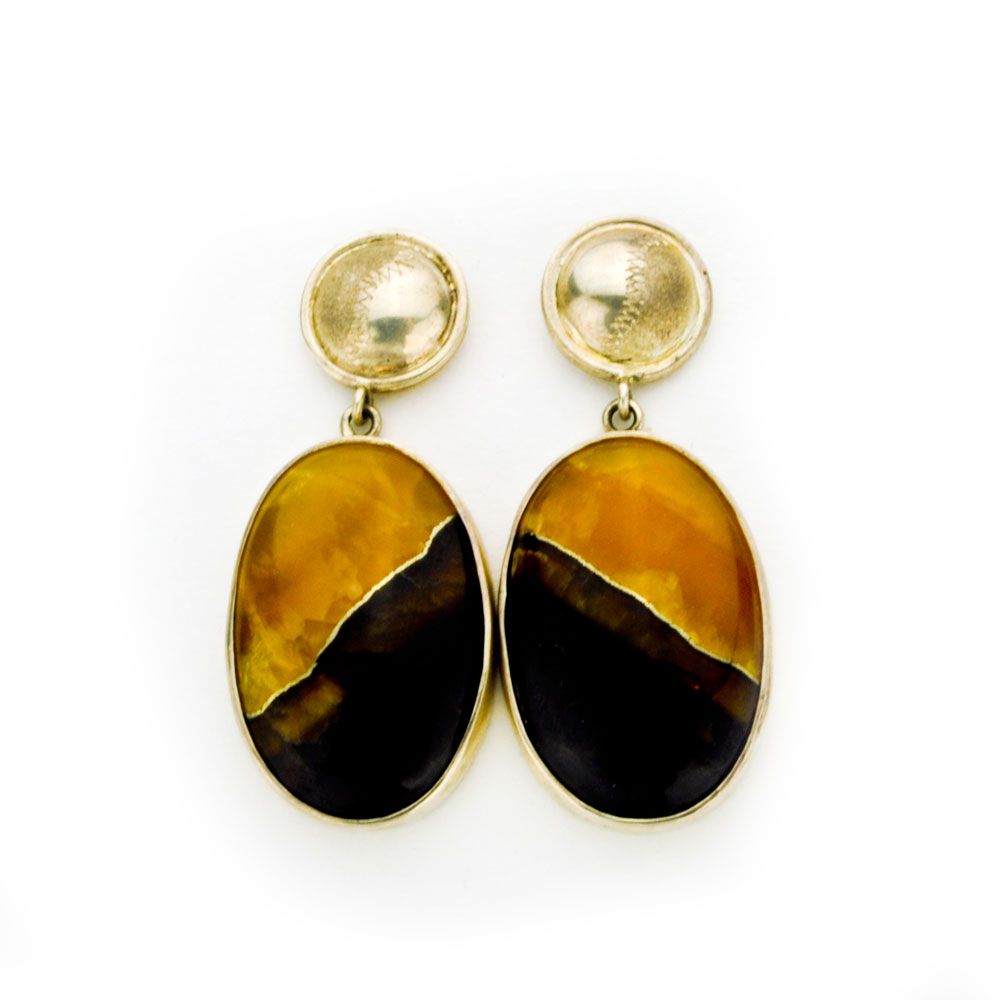
Simbercite is named after Simbirsk, Russia, the city in which it was originally found. Most of the world's simbercite is mined in Russia. So now that we know the geology about it, what to do with this stone? It is a warm stone, not just to look at, but it warms quickly when held. This stone is thought to give energy to the wearer and to alleviate fears. But more importantly, it astounds us with it's jaw-dropping natural beauty.
Showing posts with label rock. Show all posts
Wednesday, July 3, 2013
Rock Review: Simbercite
Labels:
ammolite,
folklore,
fossil,
gem healing,
gemstone,
jewelry,
mineral,
precious rock,
pyrite,
rock,
Russia,
shell,
Simbercite,
Simbircite,
Simbrisk
Friday, February 24, 2012
Rock Review: Sodalite
Today’s rock review features Sodalite.
Geology Buzz
Sodalite is a mottled gemstone that most often has creamy yellow to white tones and royal blue colors mixed throughout the stone in interesting patterns. However, it can also occur in grey, yellow, pink and green if its chemical composition varies. It is named for the element Sodium than can be found in its makeup and belongs to the Feldspar family. It registers at 6 on Moh’s scale of hardness.
Fun Facts
For care and maintenance, a soft polishing cloth will usually do the trick. A conservative dab of olive oil can also occasionally be used to enhance the luster and loosen dirt. This can be followed up with a quick rinse in warm water. Be sure to pat dry afterward. Because of its porous nature , Sodalite should not be soaked for long periods of time.
Geology Buzz Sodalite is a mottled gemstone that most often has creamy yellow to white tones and royal blue colors mixed throughout the stone in interesting patterns. However, it can also occur in grey, yellow, pink and green if its chemical composition varies. It is named for the element Sodium than can be found in its makeup and belongs to the Feldspar family. It registers at 6 on Moh’s scale of hardness.
Sodalite is usually opaque, although translucent crystals can be found in larger deposits. It takes on a waxy luster when polished. Because of this, Sodalite is often found in beaded and cabochon form in jewelry. Sodalite can often be mistaken for Lapis Lazuli, however it almost never contains pyrite flecks present in Lapis. Also, it’s color is considered “Royal Blue” rather than “Ultramarine”. In streak tests, it will leave a white, rather than blue scrape.
Fun Facts
People began using Sodalite as ornamental decoration in the late 1800’s after a substantial quantity was found in Ontario, Canada in 1891. Bancroft, Ontario is known to produce Sodalite of with notably rich blue color. The mineral also can be found plentifully in Brazil and in China.
Sodalite is popular among individuals who enjoy the metaphysical properties of gems. It is thought to bring calmness and clarity to the mind, encouraging rational thinking, intuition and verbal expression. It also enhances confidence, self esteem and trust.
For care and maintenance, a soft polishing cloth will usually do the trick. A conservative dab of olive oil can also occasionally be used to enhance the luster and loosen dirt. This can be followed up with a quick rinse in warm water. Be sure to pat dry afterward. Because of its porous nature , Sodalite should not be soaked for long periods of time.
Monday, December 20, 2010
Rock Review: Serpentine

Serpentine ( hydrated magnesium silicate)
More of a mineral than a rock, Serpentine is so named because of its green, yellow or brown hue which resembles the skin of a serpent. Handle serpentine with care because it is porous and relatively soft, ranging from 3 to 5 on the Moh’s scale of hardness (that’s out of 10). This means that it should not be cleaned with an abrasive and chemicals including perfume should be avoided.
Although you may not have heard of serpentine, it has been used for thousands of years. It was used in ancient Assyria to invoke special blessings from the gods. It has also been used as a healing stone to aid in stomach and kidney ailments when laid directly on the skin. Here is a link I found on how to alleviate back pain with serpentine: http://www.ehow.com/facts_6017079_serpentine-stone-back-pain.html
Serpentine is found in New Zealand, China, Afghanistan, South Africa, USA, England, and Italy. While it is pictured here in a striking yellow with flecks of black hematite, it is also found in many other colors. Red, green, brown-red, brown-yellow and white are other colors varieties of the same mineral substance.
Subscribe to:
Posts (Atom)