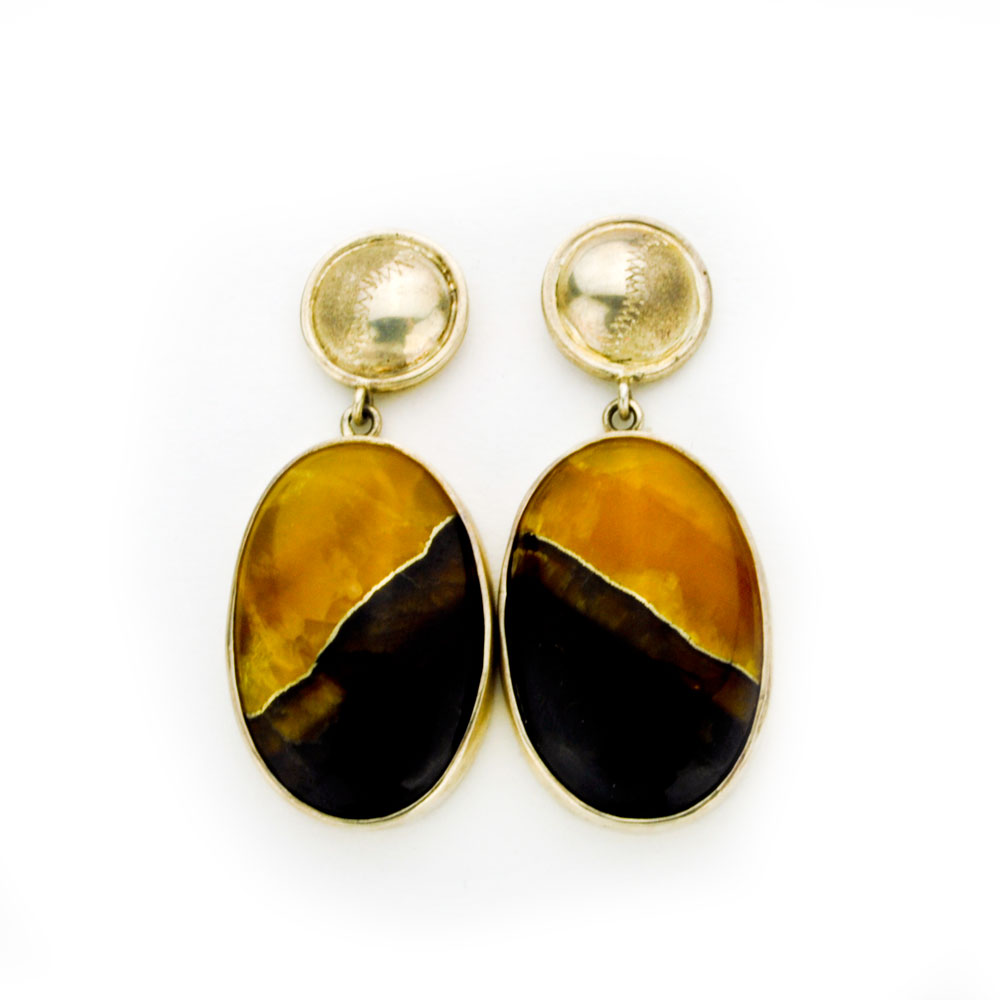
Our Rock Review today shines the spotlight on Ammolite.
Geology Buzz
Ammolite is one of the worlds few biogenic gems, in the ranks with amber, pearls and coral. Biogenic gems are formed from living creatures. Ammolite comes from small shells called Ammonites that are comprised mainly of Aragonite as well as a few other minerals like Calcite, Silica and Pyrite. The result is a gemstone with an iridescent opal-like play of color and a beautiful sheen. Ammolites are a compilation of thin layers of gem which give it it’s iridescence. Colors usually range from green to red, but can also turn up in blues and violets as well depending on the thickness of the stone layer matrix inside the gem. Rare whole Ammonite shells that have fully fossilized into Ammolite can be found occasionally also.
Ammolite scores a 4.5-5.5 on Moh’s scale of hardness and should be shielded from blows or environmental damage such as water or sun exposure. Consistent exposure to sun over time can cause the stone’s colors to fade.
Fun Facts
Ammolite is found exclusively in North America. A few locations are the Rocky Mountains and also in Canada. It is also the official gem of Alberta Canada. It’s a fairly new gem, not on the market until the 1970’s, and was given it’s gemstone status in 1981 by the World Jewelry Confederation. The Blackfeet Native American tribe has known the stone for centuries, however, calling it the Buffalo Stone. Legend has it that it aided Native Peoples in buffalo hunts by drawing the buffalo to them.
Practitioners of Feng Shui tout the stone as useful for improving one’s chi by detoxifying the body and promoting general well being. It’s nicknamed the “Seven Color Prosperity Stone” because each color is thought to benefit it’s wearer in different ways. A stone that contains, deep reds, greens and yellows is most desirable because it enhances growth, wisdom and wealth, all in one.
Ammolite Saturn Junior Bracelet by Layne Designs